
Ever looked up at the night sky and felt small?
Well, buckle up. Because once you learn about what’s actually out there, “small” doesn’t even begin to cover it.
We’re not just small. We’re microscopic. We’re invisible. We’re less than a speck of dust on a grain of sand in an ocean that stretches farther than you can imagine.
And that’s not an exaggeration. That’s science.
According to NASA’s Wilkinson Microwave Anisotropy Probe (WMAP), the universe is 13.77 billion years old, and atoms—the stuff we’re made of—make up only 4.6% of it. The rest? Dark matter and dark energy that we can’t even see.
Think about that. Everything you’ve ever touched, seen, or experienced represents less than 5% of the universe. The other 95%? We barely understand it.
If you’ve ever felt insignificant, astronomy is both the worst and best thing to study. It’s the worst because it makes you realize how truly tiny you are. But it’s also the best because it makes you appreciate how remarkable it is that we exist at all.
Today, we’re exploring 10 mind-blowing space facts that will make you feel incredibly tiny—in the best possible way. These aren’t abstract concepts. They’re verified discoveries from NASA, the Hubble Space Telescope, and astronomical research that prove our universe is far stranger and larger than most people can comprehend.
Ready to feel like the tiniest thing that ever existed? Let’s explore these mind-blowing space facts together.
Why These Discoveries Matter
Before we dive into specific discoveries, let’s talk about why understanding our cosmic insignificance is actually important.
It Puts Problems in Perspective
Stressed about work? That email that upset you? The argument you had yesterday? In the context of the universe, these things matter to you—but cosmically speaking, they’re invisible blips.
It Makes Us Appreciate Life
The odds that we exist at all are astronomically (literally) small. The universe doesn’t care about us. The fact that we’re here to wonder about our place in it is remarkable.
It Inspires Curiosity
The more we learn about space, the more questions we have. Every answer reveals new mysteries. That’s exciting.
It Unites Humanity
From space, there are no borders. No countries. No divisions. Just one tiny planet full of people who have more in common than they think.
1. Quipu: The Largest Structure in the Known Universe
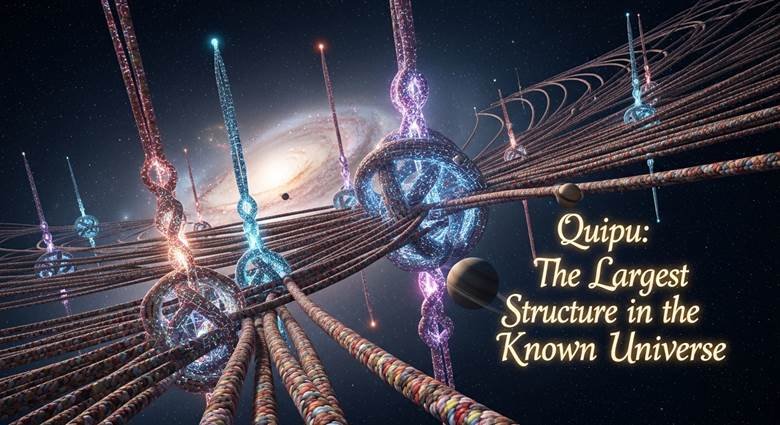
The Discovery: A superstructure spanning 1.3 billion light-years
The Mass: 200 quadrillion solar masses
What It Means: The largest cosmic structure ever discovered
The Story
In 2025, astronomers announced the discovery of what they call “Quipu”—named after the Incan system of knotted cords used for counting. This superstructure is, quite literally, the largest thing we’ve ever found in the universe.
How big is it? Quipu spans roughly 1.3 billion light-years across. To put that in perspective, light traveling at 186,000 miles per second would take 1.3 billion years to cross it.
The Scale
Quipu contains:
- Galaxy clusters and clusters of clusters
- An estimated 200 quadrillion (200,000,000,000,000,000) solar masses
- One long filament with multiple side filaments (like a knotted cord)
Along with four other superstructures discovered at the same time, Quipu contains:
- 45% of all galaxy clusters in that region
- 30% of all galaxies
- 25% of all matter
- 13% of the volume in that area of space
Why This Is One of the Most Mind-Blowing Space Facts
Before Quipu, the largest known structure was the Shapley Supercluster, which contains more than 8,000 galaxies. Quipu dwarfs it. It’s so large that it challenges our understanding of how structures form in the universe.
Remember: this isn’t just big. It’s incomprehensibly, absurdly, mind-meltingly huge. And somewhere in all that vastness, on a tiny planet orbiting an average star, you’re reading these words.
Feel tiny yet?
2. The Observable Universe: 93 Billion Light-Years Across
The Discovery: The observable universe has a diameter of about 93 billion light-years
What It Means: Even with our best telescopes, we can only see a fraction of what exists
The Catch: The universe extends far beyond what we can observe
The Story
The universe is 13.77 billion years old (according to WMAP satellite data). Logic suggests we should only be able to see 13.77 billion light-years in any direction, right?
Wrong.
Because the universe is expanding—and that expansion is accelerating—the observable universe is actually about 93 billion light-years in diameter. Objects we see now have moved much farther away since their light started traveling toward us.
The Unobservable Universe
Here’s the kicker: the observable universe is just what we can see. The actual universe? It’s likely infinite. Or at least so much larger than the observable portion that the difference doesn’t matter.
Think of it like standing in the ocean. You can see to the horizon in every direction. But does the ocean end at your horizon? No. It keeps going. The observable universe is our horizon—but space continues far beyond it.
Why This Is Mind-Blowing
Everything you’ve ever known—every person, every place, every event in human history—happened within one microscopic region of one planet, orbiting one star, in one galaxy, in an observable universe that might be just a tiny fraction of the actual universe.
And beyond our horizon? More galaxies. More stars. More space. Forever.
3. The Hubble Ultra Deep Field: 10,000 Galaxies in a Tiny Patch
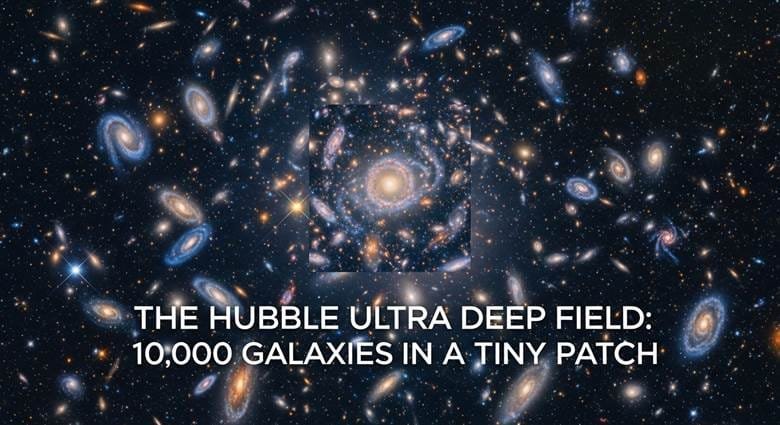
The Discovery: Nearly 10,000 galaxies visible in a speck of sky the size of a grain of sand held at arm’s length
What It Means: Galaxies are everywhere—even in seemingly “empty” space
The Observation: Hubble Space Telescope, 2004
The Story
In 2004, astronomers pointed the Hubble Space Telescope at what appeared to be an empty patch of sky in the constellation Fornax. This patch was tiny—about the size of a grain of sand held at arm’s length.
They took 800 separate exposures over 11.3 days. The cumulative exposure revealed something stunning: nearly 10,000 galaxies.
The Scale
Each of those 10,000 galaxies contains:
- Billions to hundreds of billions of stars
- Countless planets (every star likely has at least one)
- Uncountable solar systems
- Distances measured in thousands to billions of light-years
And remember: this was one tiny patch of seemingly empty sky. The entire sky contains millions of such patches.
The Math
If you could see the whole sky with Hubble’s resolution, you’d observe hundreds of billions of galaxies. Each galaxy contains billions of stars. Each star likely has planets.
The number of potentially habitable planets in the observable universe? Trillions. Maybe more.
And we’re just… here. On one planet. Orbiting one star. In one galaxy. Among hundreds of billions.
4. We’re Made of 4.6% of the Universe
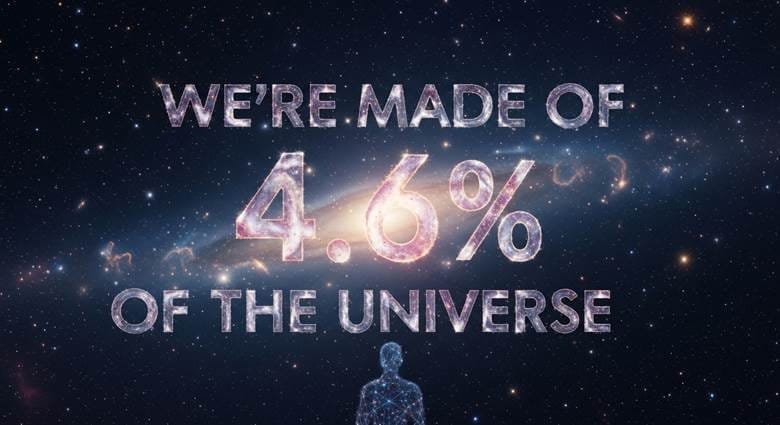
The Discovery: Atoms make up only 4.6% of the universe’s composition
What It Means: Everything we can see and touch is a tiny fraction of what exists
The Rest: 68% dark energy, 27% dark matter
The Story
NASA’s WMAP satellite measured the cosmic microwave background—the leftover radiation from the Big Bang. The data revealed something shocking about the universe’s composition.
Normal matter (atoms—everything we’re made of) accounts for just 4.6% of the universe. The rest is:
- Dark energy (68%): A mysterious force causing the universe’s expansion to accelerate
- Dark matter (27%): Invisible matter that we can only detect through its gravitational effects
What This Means
- Every star you see in the night sky? Less than 5% of what’s out there.
- Every planet, asteroid, comet? Less than 5%.
- Every human who ever lived? Less than 5%.
- Every atom in your body? You guessed it—less than 5%.
The vast majority of the universe is made of stuff we can’t see, touch, or directly detect. We’re a minority component in our own cosmos.
Why This Is Humbling
Imagine being told that 95% of your house is invisible. You can only interact with 5% of it. That’s our relationship with the universe. We exist in a tiny sliver of reality, surrounded by mysteries we barely understand.
5. Light Takes 100,000 Years to Cross Our Galaxy
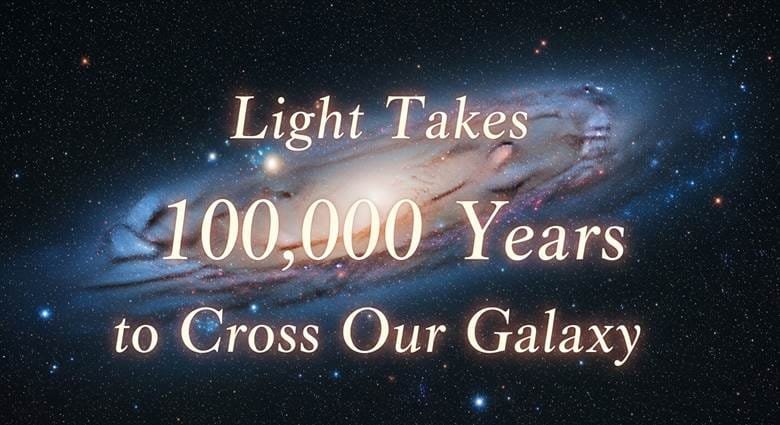
The Discovery: The Milky Way galaxy is about 100,000 light-years in diameter
What It Means: Even traveling at light speed, crossing our own galaxy takes 100,000 years
The Context: We’re located about 26,000 light-years from the galactic center
The Story
Our galaxy, the Milky Way, is a spiral galaxy containing 200-400 billion stars. It’s about 100,000 light-years across and 1,000 light-years thick at most points.
Light travels at 186,000 miles per second—fast enough to circle Earth seven times in one second. Even at that incredible speed, light takes 100,000 years to cross the Milky Way.
The Human Perspective
The fastest spacecraft humans have built is Voyager 1, traveling about 38,000 mph. At that speed, crossing the Milky Way would take:
694 billion years.
The universe is only 13.77 billion years old. You could traverse the universe’s entire age 50 times over and still not cross our galaxy at Voyager’s speed.
The Lonely Truth
We’re isolated in space by distance. Even if intelligent life exists elsewhere in our galaxy, we might never meet. The distances are too vast. The travel times too long.
When you look at the night sky, you’re seeing light from stars thousands of light-years away. If they exploded yesterday, we wouldn’t know for thousands of years. We’re seeing the past. Always the past. Never the present.
6. There Are More Stars Than Grains of Sand on Earth
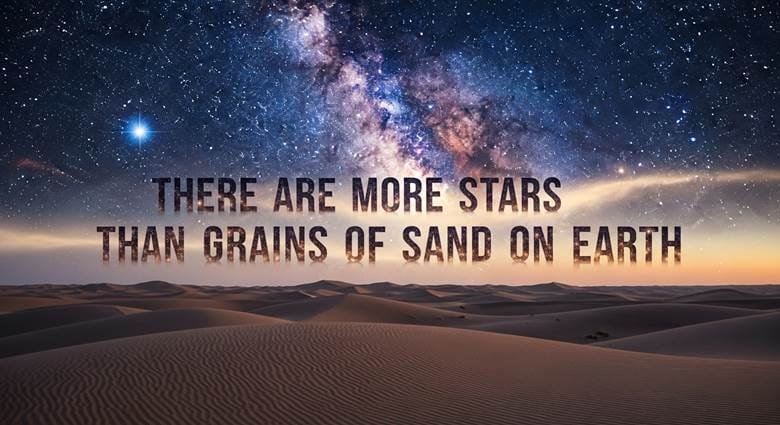
The Discovery: The observable universe contains more stars than all the grains of sand on all Earth’s beaches
The Estimate: At least 200 billion trillion stars (2 × 10²³)
What It Means: Stars outnumber beach sand grains
The Story
This is one of the most repeated mind-blowing space facts, and it’s absolutely true.
Earth’s beaches contain approximately 7.5 × 10¹⁸ grains of sand. That’s 7.5 quintillion—a number so large it’s hard to comprehend.
The observable universe contains an estimated 200 billion trillion stars (2 × 10²³). That’s about 10,000 times more stars than sand grains.
The Breakdown
Our Milky Way galaxy alone contains 200-400 billion stars. And there are approximately 200 billion galaxies in the observable universe (possibly more).
Do the math: 200 billion galaxies × 200 billion stars per galaxy = way more stars than sand grains.
The Sobering Reality
Each of those stars could have planets. Many probably do. Some probably have conditions suitable for life.
Somewhere out there, on planets orbiting stars in distant galaxies, there might be beings looking at their sky, feeling just as tiny as you do right now.
7. The Tarantula Nebula: A Stellar Nursery Spanning 1,800 Light-Years
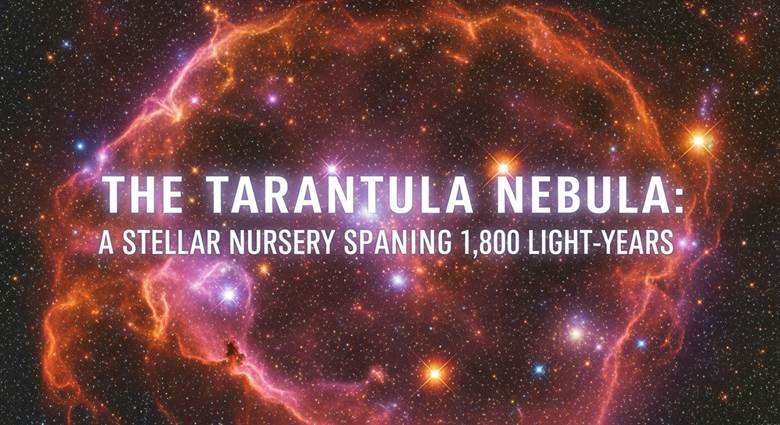
The Discovery: The largest and most active star-forming region in our local galactic neighborhood
The Size: Over 1,800 light-years across at its longest span
The Location: 170,000 light-years away in the Large Magellanic Cloud
The Story
The Tarantula Nebula (also called 30 Doradus) is a massive cloud of gas and dust where stars are being born. It’s located in a small satellite galaxy that orbits the Milky Way.
At 1,800 light-years across, the Tarantula Nebula is so large that if it were located where the Orion Nebula is (1,500 light-years from Earth), it would span 30 degrees of sky—about 60 times the diameter of the full moon.
What’s Inside
Within the Tarantula Nebula:
- Hundreds of thousands of young, massive stars
- Gas and dust spanning hundreds of light-years
- Regions where new stars are actively forming
- Some of the largest stars ever discovered
This single nebula contains more star-forming activity than the entire Milky Way galaxy.
Why This Matters
Stars are forming in a region larger than we can comprehend. Each new star might have planets. Some might support life. And this is just one nebula in one galaxy among hundreds of billions.
The universe isn’t static. It’s constantly creating new stars, new planets, new possibilities. And it’s been doing this for 13.77 billion years.
8. SPT2349-56: A Collision of 14 Galaxies
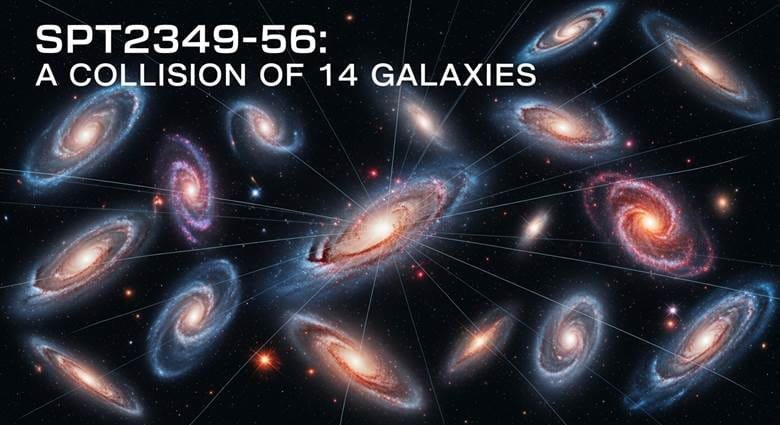
The Discovery: 14 galaxies colliding and merging into one massive structure
The Size: Eventually will form a single galaxy weighing 10 trillion solar masses
The Location: When the universe was only 1/10 its current age
The Story
Astronomers discovered protocluster SPT2349-56—a cosmic pileup where 14 galaxies began crashing together when the universe was only 1.4 billion years old (about 10% of its current age).
These galaxies are squeezed together in a space only about three times the size of the Milky Way. They’re merging together through gravitational attraction, eventually forming what will be one of the most massive galaxies in the universe.
The Megamerger
When complete, this megamerger will create:
- A single galaxy weighing 10 trillion solar masses
- One of the largest galaxies in the universe
- A structure visible across cosmic distances
Additionally, about 50 other galaxies surround this core structure, which will eventually settle into a gigantic galactic cluster.
The Perspective
Entire galaxies—each containing hundreds of billions of stars—are colliding and merging. This process takes hundreds of millions to billions of years. It’s happening on scales and timescales we can barely conceive.
And somewhere in all that chaos, planets are forming. Stars are being born. Perhaps life is emerging. Or maybe it’s being destroyed. Either way, the universe continues its cosmic dance, completely indifferent to our existence.
9. The Cosmic Web: The Universe’s Hidden Structure
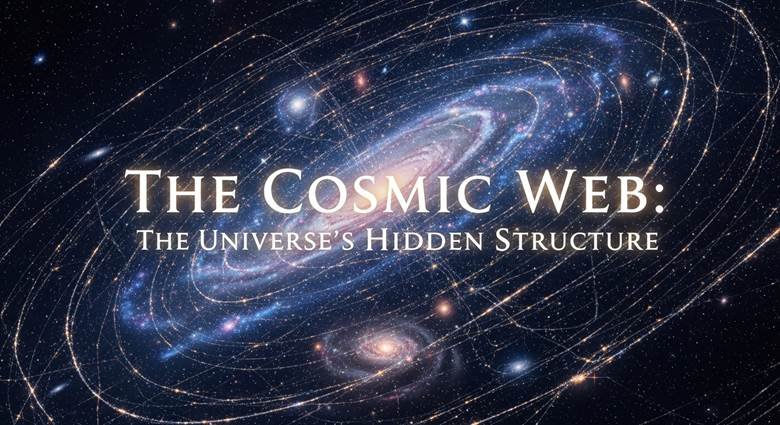
The Discovery: Galaxies are arranged in vast filaments and sheets forming a cosmic web
The Scale: Spans the entire observable universe
What It Means: The universe has structure on the largest scales imaginable
The Story
According to NASA observations, galaxies aren’t randomly scattered through space. Instead, they’re arranged in enormous threadlike structures called the cosmic web.
This web forms as gravity draws matter together into concentrations, creating:
- Galaxy filaments (like threads)
- Galaxy walls (like sheets)
- Galaxy clusters (where filaments intersect)
- Cosmic voids (empty spaces between structures)
The Sloan Great Wall
One of the largest structures ever found, the Sloan Great Wall, spans about 1.4 billion light-years. It’s a vast sheet of galaxies forming one section of the cosmic web.
The first galactic wall discovered, the Coma Wall, is about 500 million light-years long and 300 million light-years away.
What This Reveals
The entire universe has structure. On the largest scales, matter organizes itself into patterns that span billions of light-years. Galaxies rest on these structures like beads on cosmic strings.
We exist on one tiny planet, in one galaxy, resting on one thread in a cosmic web that spans the entire observable universe.
10. Dark Energy Is Expanding the Universe Faster
The Discovery: The universe’s expansion is accelerating, not slowing down
The Cause: Dark energy—making up 68% of the universe
What It Means: Eventually, distant galaxies will move beyond what we can ever see
The Story
In 1998, astronomers studying distant supernovae made a shocking discovery. They expected the universe’s expansion to be slowing down due to gravity. Instead, they found the opposite: the expansion is accelerating.
This discovery revealed the existence of “dark energy”—a mysterious force that permeates space and drives everything apart.
The Ultimate Fate
Because of dark energy:
- The universe will expand forever
- Eventually, distant galaxies will accelerate beyond the speed of light (relative to us)
- In trillions of years, only our local galaxy cluster will be visible
- The rest of the universe will have moved beyond observation
The Lonely Future
Future civilizations billions of years from now might look at the sky and see only darkness. The evidence of the Big Bang, distant galaxies, and the cosmic web will have disappeared beyond their cosmic horizon.
They might conclude they live in a small, static universe containing only their own galaxy cluster. They’d be wrong—but they’d have no way to prove it.
Why This Matters Now
We live in a special time. We can see the universe’s history. We can observe distant galaxies. We can study the cosmic web. But this won’t last forever. The universe is moving away from us, faster and faster, driven by a force we barely understand.
What These Mind-Blowing Space Facts Mean for Us
After exploring these discoveries, some patterns emerge about our place in the cosmos:
We’re Incredibly Small
From Quipu’s 1.3-billion-light-year span to the 93-billion-light-year observable universe, the scales involved dwarf human comprehension. We’re not just small—we’re invisible on cosmic scales.
We’re Incredibly Lucky
The odds that Earth exists at all—with the right conditions for life—are astronomically small. Add to that the improbable emergence of complex life, intelligence, and civilization, and our existence seems almost miraculous.
We’re Connected to the Cosmos
Every atom in your body was forged in the heart of dying stars. You’re literally made of stardust. The iron in your blood, the calcium in your bones, the oxygen you breathe—all created in stars billions of years ago.
We’re Observers of Something Magnificent
Despite our size, we can observe and understand the universe. We can measure distances spanning billions of light-years. We can detect structures larger than anything we can physically experience. That’s remarkable.
We’re Alone (As Far As We Know)
Despite the trillions of planets that probably exist, we haven’t found evidence of other intelligent life. Whether we’re truly alone or just haven’t looked hard enough remains one of science’s biggest questions.
Interactive Challenge: Scale It Down
Ready to truly grasp how tiny we are? Try this scaling exercise:
The Scaled Universe
If the Sun were the size of a basketball (9.5 inches):
□ Earth would be the size of a peppercorn (0.09 inches) located 26 feet away
□ Jupiter would be the size of a golf ball 135 feet away
□ Neptune would be 811 feet away (longer than two football fields)
□ The nearest star (Proxima Centauri) would be 1,400 miles away
Now scale up to the galaxy:
□ The Milky Way would be 100 million miles across
□ The nearest galaxy (Andromeda) would be 2.5 million miles away
□ The observable universe would span 900 trillion miles
Reflection Question: Can you visualize these distances? No? That’s exactly the point. The universe is too large for human brains to truly comprehend.
Frequently Asked Questions
Does knowing we’re tiny make life meaningless?
Not at all. Cosmic insignificance doesn’t mean personal insignificance. You matter to the people around you. Your actions affect your world. Meaning comes from relationships, experiences, and how we treat each other—not from our cosmic importance.
Are we alone in the universe?
We don’t know. Given the trillions of planets that probably exist, many scientists think life elsewhere is likely. But intelligent, technological civilizations? That’s harder to predict. So far, we haven’t found evidence of other intelligent life.
Will humans ever travel to other galaxies?
Almost certainly not. The distances are too vast and the time scales too long. Even reaching nearby stars would take thousands of years with our current technology. Traveling to other galaxies would take millions or billions of years.
Why can’t we see the whole universe?
Light travels at a finite speed, and the universe is only 13.77 billion years old. We can only see light that’s had time to reach us. Additionally, the universe’s expansion means some parts are moving away faster than light can travel, making them permanently invisible to us.
Does the universe have an edge?
Probably not. The observable universe has an edge (our cosmic horizon), but the actual universe likely doesn’t. It might be infinite, or it might curve back on itself like the surface of a sphere. We don’t know for sure.
What existed before the Big Bang?
We don’t know. Some theories suggest time itself began with the Big Bang, making “before” meaningless. Other theories propose cyclic universes, multiverses, or eternal inflation. This remains one of the biggest unsolved questions in physics.
How do scientists measure these enormous distances?
Astronomers use several methods: parallax for nearby stars, standard candles (like certain supernovae) for distant galaxies, and redshift measurements to determine how far away and how fast objects are moving. Each method has been carefully calibrated and verified.
The Bottom Line
These 10 mind-blowing space facts reveal just how tiny we are in the grand scheme of things. From Quipu’s 1.3-billion-light-year span to the revelation that we’re made of just 4.6% of the universe, the cosmos constantly reminds us of our microscopic place in existence.
But here’s the beautiful paradox: despite being incomprehensibly tiny, we’re also remarkably significant.
We’re the universe’s way of observing itself. We’re complex patterns of stardust that can wonder, create, love, and understand. We’re conscious beings capable of measuring distances billions of light-years away and comprehending structures larger than imagination.
These discoveries don’t diminish us—they elevate us.
Yes, we’re tiny. But we’re also:
- The only known intelligent life in the observable universe
- Capable of understanding our own insignificance
- Able to send spacecraft beyond our solar system
- Constantly expanding our cosmic horizons
As Carl Sagan said: “The cosmos is within us. We are made of star-stuff. We are a way for the universe to know itself.”
So the next time you feel stressed about daily problems, remember: you’re standing on a tiny planet orbiting an average star in one galaxy among hundreds of billions, in a universe so vast it contains structures spanning over a billion light-years.
Your problems matter. But they’re also beautifully, wonderfully tiny in the grand cosmic scheme.
And that’s okay. That’s perfect, actually. Because it means you’re free to focus on what really matters: the people you love, the experiences you have, and the tiny corner of the universe you get to inhabit for a brief, miraculous moment.
Feel tiny? Good. Now go make your tiny piece of the universe a little better.
About This Article: This guide explored 10 space discoveries that demonstrate the scale of the universe, with all astronomical facts verified through NASA sources, Hubble Space Telescope data, peer-reviewed research published in Monthly Notices of the Royal Astronomical Society, ScienceDaily reports, and data from the Wilkinson Microwave Anisotropy Probe (WMAP). All measurements, distances, and discoveries are factual and scientifically documented.
Want to explore more? Visit NASA’s official website, the Hubble Space Telescope gallery, and the European Space Agency for stunning images and up-to-date astronomical discoveries.
All astronomical data verified from authentic sources including NASA, Hubble Space Telescope, WMAP satellite, European Space Agency, ScienceDaily, Monthly Notices of the Royal Astronomical Society, and peer-reviewed astronomical research. No fictional or speculative information presented as fact